

What is a Stakeholder Engagement Matrix?
A Stakeholder Engagement Assessment Matrix enables us to create a stakeholder engagement plan by comparing current and desired stakeholder engagement. It takes stakeholder mapping to the next level by classifying stakeholders into five classification groups: unaware, resistant, neutral, supportive, leading. Once you map your stakeholders, you can create engagement plan to take them from their current state of engagement (C) to a desired state of engagement (D).
Why is it important?
A Stakeholder Engagement Matrix is important because it forms the basis of the stakeholder engagement plan. Not all stakeholders require the same level of engagement in a project, while any resistant stakeholders might need a more systematic approach. This assessment enables project managers to track any risk posed by stakeholders so that an effective stakeholder engagement plan can be created for the project.
How to create a Stakeholder Engagement Matrix?
There a few ways in which you can create a Stakeholder Engagement Matrix so make it your own. Here is the approach I use.
- Stakeholder column: List key stakeholders who will impact the success of your project. If several stakeholders belong to the same position/category and you can apply the same strategy for them, you can group them by position/category.
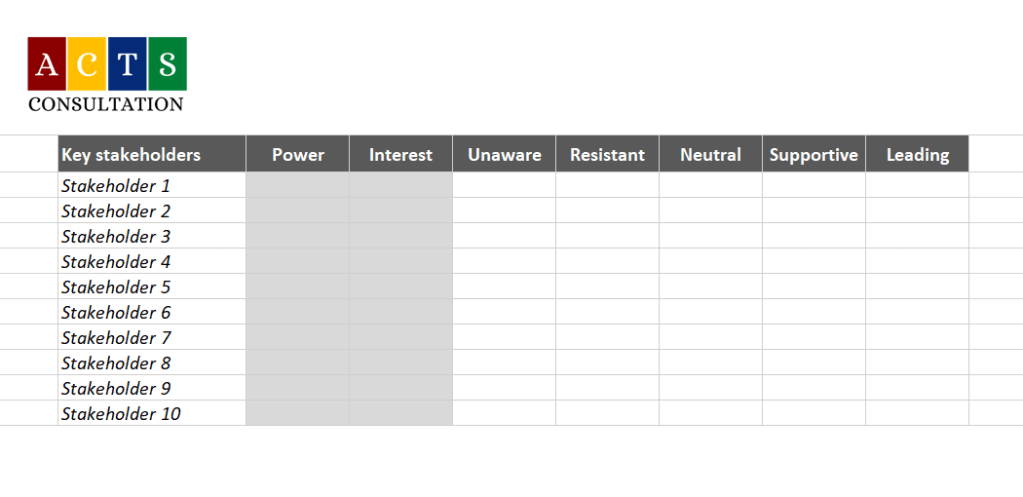
2. Power/interest column: This is part of stakeholder mapping that I prefer adding to this matrix because it captures the assessment in one spot. Create a column to track stakeholder power/influence and another column to track interest. Analyze the influence and interest each of your key stakeholders can have in your project and write high or low based on your analysis. This helps narrow down the focus on stakeholders who have high power/influence so you can create a stakeholder management plan based on their level of interest.
3. Classification columns: Complete the classification columns based on the current (C) and desired (D) level of stakeholder engagement as shown in the example below. The Project Management Body of Knowledge suggests the following classification, which forms the standard for a stakeholder engagement matrix.
- Unaware
- Resistant
- Neutral
- Supportive
- Leading
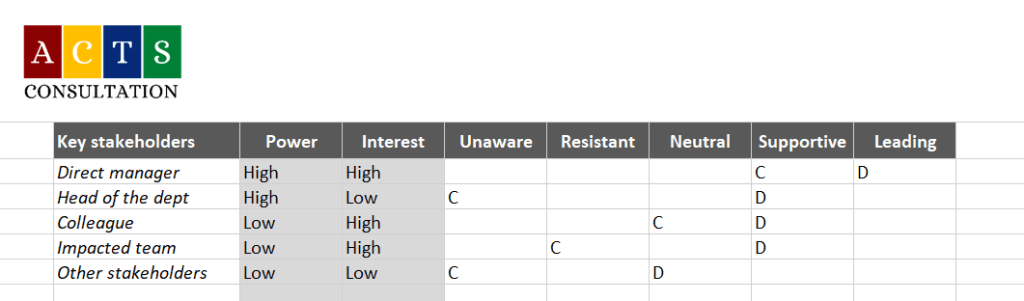
4. Based on this matrix, design your stakeholder engagement plan to determine how you plan to engage your stakeholders to support project success. The key to a successful plan is to be consistent and timely with your stakeholder engagement efforts instead of being irrelevant or over-communicative.
This is a dynamic document that should be kept updated for the different project phases as the stakeholder engagement plan evolves to meet project needs.
Who should have access to the stakeholder engagement matrix?
The Stakeholder Engagement Matrix may have sensitive stakeholder information and therefore, should not be widely shared. Use it as a project manager, share it with the project sponsor and core project team as needed.
 Acts Consultation
You must be logged in to post a comment.